
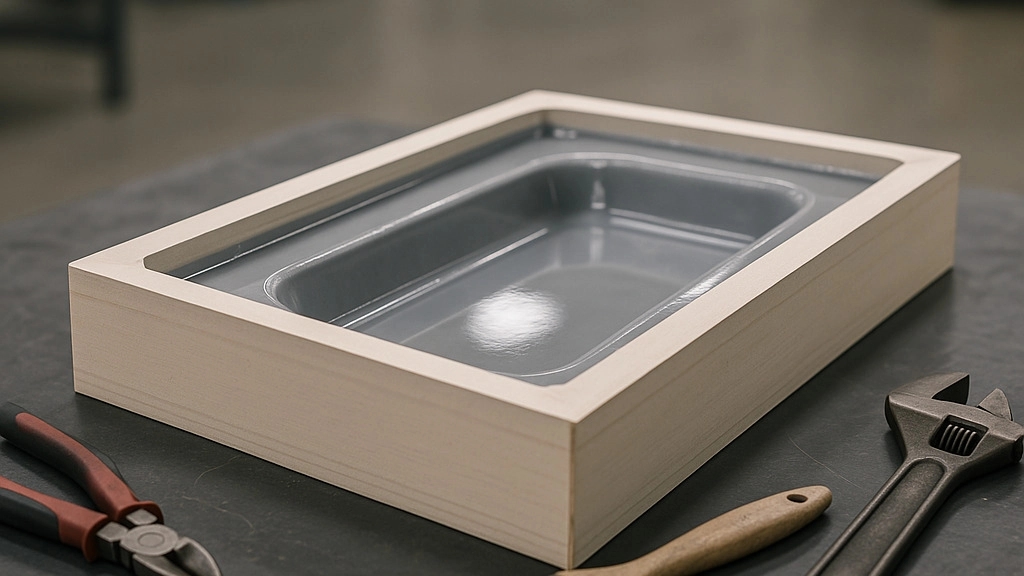
why handmade mold with epoxy glue?
The use of handmade molds for many reasons and the prominent benefits it offers has gained significant growth in various industries. These benefits include:
High Production Speed: Unlike metal molds that require precise machinery, milling and time -consuming turning, epoxy molds are made using a layering or layering process that is much faster. This speed in production allows faster to meet market needs and more early product entry into the market.
Lowest Cost: The raw materials needed to make epoxy molds, ie epoxy resin and hardener, are cheaper than precious metals such as steel. In addition, the costs of machinery and skilled workforce in the construction of metal molds are far higher, which is greatly reduced in epoxy molds.
Complex Details: Epoxy adhesive in liquid mode can penetrate the smallest details and negative spaces of the original model. This feature makes the final template reproduce all the details and delicacies of the original design with great accuracy. This is crucial for components that require high accuracy and excellent payment level.
Easy Customization: Due to the nature of the process, changes and modifications in the design of epoxy molds are far easier than metal molds. This enables manufacturers to respond quickly to the specific needs of customers and produce customized versions of high flexibility products.
High resistance: epoxy adhesive is known as one of the most durable polymer materials. After complete drying and hardness, epoxy has high compressive and tensile strength and is well resistant to wear, chemicals, moisture and temperature changes. This resistance extends the life of the mold and makes it suitable for frequent parts of the components
Compatibility with a variety of raw materials: Epoxy molds are well adapted to different types of plastic raw materials used in the vacuum forming process or other thermal formation methods. This compatibility is due to the smooth and non -adhesive surface of the epoxy after full baking, which allows the final piece to be separated.
Careful formation guarantee: Epoxy thermostat properties after baking lead to high dimension stability. This stability ensures that the mold does not deform during the production process and under the influence of temperature and pressure, and the components are produced with high dimensions and uniform dimensions.
Handmade Epoxy Mold Production in Hope
"Hope Vacuum Forming Company" Company is recognized as a leader in this industry with many years of precious experience and deep expertise in the field of industrial mold production and design. With a thorough understanding of the variable market needs of the market and the importance of productivity and quality in production, this collection has been able to market the highest quality, extraordinary durability and precision by utilizing up -to -date technical knowledge and using high quality and standard epoxy adhesives.
what is epoxy glue and why is it suitable for handmade mold?
epoxy glue is a two -component compound that, after mixing, is firmly tightened and has a very durable structure. These features have made epoxy adhesive one of the first choices in the manufacture of handmade mold, made from epoxy glue.
handmade mold production steps, prepared from epoxy adhesive
One of the most important points in the manufacture of handmade molds is epoxy glue, adhering to technical principles and familiarity with construction details.
The standard mold production steps are as follows:
1. Preparation of the initial model
The initial model can be any arbitrary object from which the handmade mold, made from epoxy glue. The model should be thoroughly cleaned and, if necessary, cover the surface with the separator so that the epoxy does not stick to the model.
1. Choose the right template Depending on the type of application and the final piece, you can make a single or multi -piece mold. This section depends entirely on the need for the project, and the Hope Vacuum Forming Specialists with years of experience offers the best solution to customers.
1. Soften and mix epoxy glue By following the correct ratio (often as the manufacturer's instruction), you mix two epoxy adhesive components. This step requires high accuracy because the quality of the mold depends entirely on the correct composition.
1. Pouring epoxy glue on the model After mixing, gently pour epoxy glue on the initial model to cover the entire surface. To prevent bubbles from creating bubbles, it is recommended to do so in a few steps.
1. Drying and separating mold Depending on the type of epoxy glue, the drying time may vary (usually 1 to 2 hours). After ensuring complete drying, you remove the mold, and now a handmade mold, made from epoxy glue, is ready to use.
handmade mold applications, prepared from epoxy adhesive
Industrial Parts Production In the production of machinery parts, industrial equipment and special sections that require low circulation, handmade mold, made from epoxy glue, is a great option.
Art and Decorative Industries Sculpture, resin jewelry design, decorative supplies, all require epoxy handmade molds that create great details at the lowest cost.
Construction and Architecture Industries Epoxy molds have made a big change in the manufacture of special forms of plaster, architectural panels, facades and construction decor components.
Packaging Industries and Vacuum Forming One of the main customers of handmade molds is epoxy glue, a veto -forming industry that makes it possible to build molds for packaging, containers and consumables.
Why is the epoxy handmade template necessary for a vacuum for forming?
In the vacuum, the plastic plates are softened by heat and inserted into the mold to take the shape. A template made of low -quality materials, after several stages of use, becomes deformed, fractured or burns and disrupts the production process. Handmade mold, made from epoxy glue, is an ideal choice for the industry due to thermal stability and excellent resistance, and the experience of dozens of Vacuum for Hope Vacuum is evidenced by this claim.
Hope Vacuum Forming Company, with years of experience in making epoxy handmade molds, has successfully completed many projects in various industries. From cosmetic packaging to sophisticated industrial parts, all of these projects are done with handmade epoxy templates and customer satisfaction is the most important brand capital.
Summary and conclusion Handmade mold, made from epoxy glue, is a key tool in the art, industrial and construction industries that allow precise and distinct parts. The use of epoxy glue has advantages such as high resistance, flexibility and longevity for the mold. A reputable manufacturer of Hope Vacuum Forming by providing quality epoxy templates and unique services is a reliable choice for your projects. Simply leave your project to the Hope Team to experience success and satisfaction.