
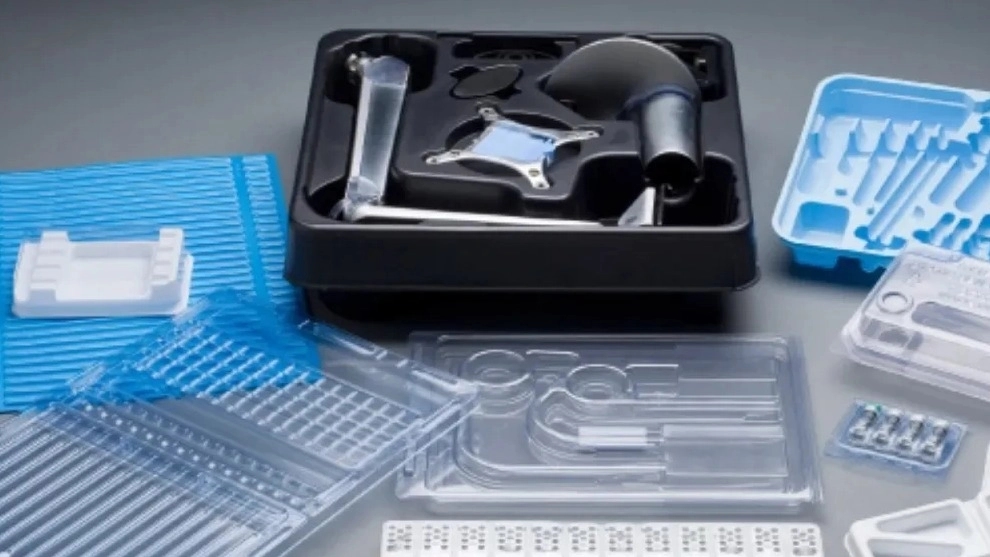
What is vacuum forming and what are its uses?
- Packaging of food and pharmaceutical industries: Production of disposable containers, medicine blisters and food storage containers.
- Automotive industry: Production of car interior parts, dashboards, protective shields and plastic decorations.
- Household appliances: Production of refrigerator internal body, washing machine parts and protective covers.
- Packaging of cosmetic products and Hygienic: Creating stylish protective structures for perfumes, cosmetics and hygiene tools.
First phase: engineering design and simulation in Omidan vacuum
Detailed analysis of customer needs
3D design and computer simulation
Second phase: making and preparing specialized molds
Wooden and MDF molds
Resin and composite molds
Aluminum molds (CNC machining)
The third phase: preparation and feeding of raw materials
Types of consumable polymer sheets
- Polystyrene (PS / HIPS): The most widely used material for packaging containers, sanitary trays and light parts due to its excellent plasticity and reasonable price.
- Acrylonitrile butadiene styrene (ABS): It has very high impact resistance, excellent hardness and is suitable for industrial and automotive parts.
- Polyethylene terephthalate (PET): Excellent transparency. High and suitable for food and drug packaging that require health approval.
- Polyvinyl chloride (PVC): Suitable flexibility and high chemical resistance, applicable in vacuum card and blister packaging.
Cutting and preparation of sheets
The fourth phase: the main thermal forming process (vacuum forming)
1. Loading the sheet and fixing it (Clamping)
2. Preheating (Heating)
The plastic sheet is irradiated by advanced thermal elements (mainly ceramic or infrared radiation elements). In modern Omidan Vacuum machines, furnace temperature control is done intelligently and zoned. This feature makes the heat reach all points of the sheet completely uniformly so that the plastic becomes a paste and flexible (not melted).
3. Pre-Stretch / Bubble Blow
In parts that have a great depth, to prevent the walls of the part from thinning, after the sheet is heated, compressed air is blown under the sheet to form a symmetrical bubble. This work improves the thickness distribution of the sheet during contact with the mold.
4. Air evacuation and creating a vacuum (Vacuum Action)
At this stage, the die is raised to the sheet (or the sheet sits on the die). Immediately, the strong vacuum suction pumps are activated and quickly drain the trapped air between the plastic sheet and the mold. The created atmospheric pressure makes the plastic paste sheet completely adhere to the surfaces and corners of the mold and take the exact shape of the mold. In semi-automatic and fully automatic Imand Vacuum devices, this step is planned and executed with a hundredth of a second precision.
5. Cooling of the part
Once fully formed, the hot plastic part must be cooled to regain its solid state. This process is accelerated with the help of air blowing fans and cold water misting systems (if using an aluminum mold with a water circulation channel). Uniform cooling prevents asymmetric shrinkage and complexity of the part.
6. Demolding the part from the mold
After cooling, the reverse air flow (Footek or crystal) is directed into the mold so that the part can be easily removed from the mold without damage.
The fifth phase: cutting, trimming and finishing operations
The piece coming out of the vacuum forming machine still has excess edges and extra sheets around the mold that need to be removed. In the Imand Vacuum collection, post-production operations are carried out with very high precision.
Manual cutting and die-cutting
For parts with simpler designs and medium circulations, diecut presses and blade molds (steel) are used to cut extra edges, which has a high speed in finishing work.
CNC five-axis cutting
For complex industrial parts, automotive parts and special enclosures that require 3D cuts, precise holes and special angles, the trimming process in Imand Vacuum is done with the help of five-axis CNC cutting machines. This reduces human error to zero and delivers perfectly smooth edges without pleats.
Quality control and final packaging in Omidan vacuum
Maintaining stable quality during the mass production process is the main policy of Emand Vacuum series. At the end of the production process, all parts are under the supervision of the quality control unit (QC). In this unit, the following factors are evaluated:
After the final approval, the parts are placed in safe and standard packaging to prevent damage during transportation and are ready to be sent to customers.
Why choosing Omidan vacuum collection is a smart option?
Omidan Vacuum Collection, relying on years of brilliant experience in the field of plastic thermoforming, has been able to concentrate a complete chain of design, molding, production and final processing services in one collection. This integration of processes has significantly reduced project delivery time and increased quality control in each production step. The use of advanced technologies and continuous optimization of processes in Imdan Vacuum guarantees a perfect, cost-effective output that meets the exact needs of various domestic and export industries.